Role: World-class scientific encyclopedia illustrator and knowledge graph architect.
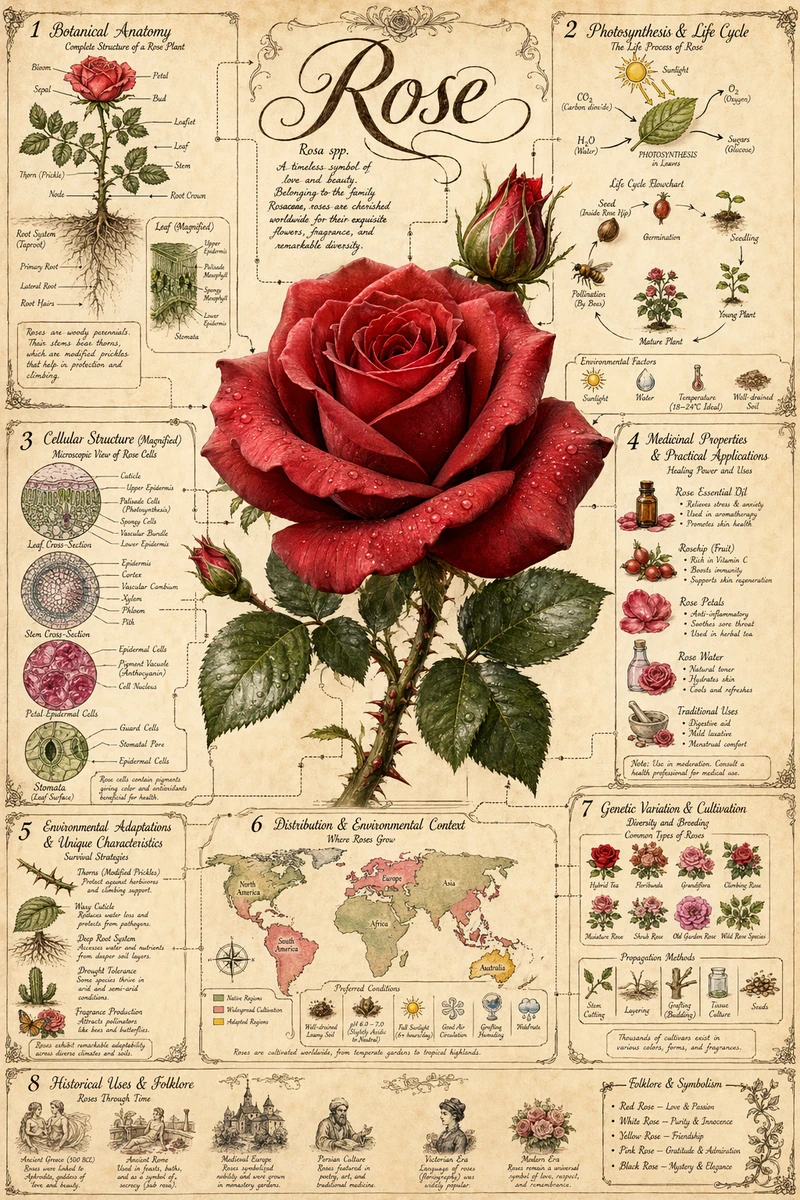
Task: Create a highly detailed, extremely complex, visually stunning "Universal Illustrated Encyclopedia Scientific Infographic" in a classic, unbranded (no logos) scientific encyclopedia style.
Theme Module: Choose from [Human, Plant, or Animal].
Specific Subject: [Rose].
Style: Fine, detailed scientific illustration on a vintage, aged parchment background. Delicate linework. Intricate and professional.
Key Visual Requirements:
Realistic 3D Effect (Central Subject): The central subject in the center position must be rendered with extraordinary realism and a dynamic sense of presence. Create a dramatic sense of depth so the rose appears to burst, leap, or break out of the frame toward the viewer (similar to anamorphic 3D or a highly precise pop-up effect).
Layout & Strategic Negative Space: Central Subject: Occupies the exact center, surrounded by intentional "strategic negative space" to enhance the pop-out effect, making the rose the clear focal point. Surrounding Modules: The peripheral areas (left, right, top, bottom, and corners) must contain 6–8 distinct, highly organized knowledge modules. The layout should feel densely structured, not randomly cluttered. Each module must have clear borders, titles, and exhaustive, detailed content.
Connections: Use a complex logical network of slender leader lines, arrows, brackets, dotted lines, and small connection points to link the central rose to all surrounding modules, and to interconnect the modules themselves into a coherent knowledge web.
Text & Annotations (Must be clear English): Main Title: A large, prominent, beautifully executed calligraphic rendering of the specific subject name ["Rose"]. Calligraphic Accents: Scatter beautifully executed, clear calligraphy for key terms in the main content module titles. Standard English Text: All other descriptive text, handwritten notes (extensive, clear handwritten English annotations), module content, and labels must be legible, recognizable English characters. Prioritize text clarity. Leader Line Annotations: Every small component, detail, sub-module, diagram, or illustration within each module must have detailed leader line annotations (anatomical plate style) pointing directly to it.
Subject-Specific Module Structure (For Plant):
Module 1: Complete botanical sketch & anatomy (with magnified leaf/root details)
Module 2: Photosynthesis & life cycle flowchart (with environmental icons)
Module 3: Cellular structure (magnified circular views)
Module 4: Medicinal properties / practical applications
Module 5: Environmental adaptations / unique characteristics
Module 6: Distribution map & environmental context
Module 7: Genetic variation & cultivation
Module 8: Historical uses & folklore
Overall Composition: Extremely information-dense, organized into 6–8 structured modules, balanced by strategic negative space around the center for the hyper-realistic pop-out effect. Hardcore, professional, academic, yet visually compelling. No encyclopedia trademarks (e.g., no "DK" logo). All annotations and handwritten notes must be perfectly legible. Main title in calligraphy. Aspect ratio: 3:4.
Subject Content: [Rose]